

 160 views
A lot of people start trying to lose weight with a simple assumption: I’m eating healthy, so I should be losing fat. And when that doesn’t happen, it feels confusing.
You’ve switched to smoothies. Salads. Nuts. Maybe oats for breakfast. Less junk. More “clean” food.
But the scale barely moves. Or worse: it moves for a week and then stops.
That’s where frustration usually begins. Because most people are making an honest effort. They’re just missing one important layer: How much they’re actually eating. That’s where calorie tracking becomes useful. Because sustainable weight loss usually becomes much easier when you understand what your body is actually taking in.
Why “Eating Healthy” Doesn’t Always Lead to Weight Loss
This is one of the biggest misunderstandings in nutrition. Healthy food and fat loss are not automatically the same thing. A food can be nutritious and still be calorie-dense.Take peanut butter. Healthy? Yes. Easy to overeat? Also yes.Same with nuts. Smoothies. Granola. Even salads can quietly become heavy when dressings, oils, cheese, and toppings start piling on.That’s the tricky part.A lot of people clean up food quality but never notice how portions change. And because the food feels “healthy,” they assume it must be helping.
A food can support health and still make fat loss harder if the quantity quietly gets out of hand.
That’s where calorie awareness changes the conversation. Because before you can manage intake, you need to understand what calories actually are.
What Calories Actually Are And Why They Matter More Than People Think
Calories are simply units of energy. That’s all. They are not bad. They are not something to “avoid.” They’re just the way we measure how much energy food gives the body. And your body needs energy for everything. Not just workouts.
Breathing. Thinking. Digesting food. Walking. Recovering. Sleeping.
Even sitting here reading this uses energy. That’s why calories matter. Your body is constantly using them. Calories are simply the currency your body uses to function. Once that’s clear, the bigger question becomes easier: What determines whether you lose fat or gain it? That comes down to energy balance.
The Real Rule Behind Fat Loss: Energy Balance
At some point, every fat-loss strategy comes back to the same equation:
How much energy is coming in versus how much is going out. This is energy balance. If you eat more than your body uses, weight tends to go up. If you eat less than your body uses, weight tends to come down. That gap is what we call a calorie deficit. And this is where a calorie-deficit weight-loss calculator becomes useful, because it helps estimate the gap.
Fat loss doesn’t happen because you cut carbs. Or because you stopped eating after 8 PM. Or because you drank detox water.
It happens because over time, your body needs more energy than it receives. That’s when stored energy (including body fat) starts getting used. Sometimes that can mean eating slightly less. Sometimes it means moving slightly more. Usually, it’s both. And once you understand that, counting calories becomes much less intimidating. It becomes practical.
Why Counting Calories Helps People Lose Weight
A lot of people hear calorie tracking and immediately think of obsession. But that’s not what it has to be. At its best, counting calories to lose weight is simply a way of seeing more clearly. It helps you notice things you would otherwise miss. The extra oil while cooking. The sugar in three cups of chai. The sauces. The bites between meals. The handful of snacks didn’t feel like much.
Those things add up.
And without tracking, they’re easy to underestimate. Tracking also gives structure. It tells you where your intake stands without relying on guesswork. And maybe most importantly, it creates flexibility. You can still eat foods you enjoy. You just understand how they fit. Counting calories is less about control and more about clarity. And once you have that clarity, the next question becomes obvious:
How much should you actually eat?
How Many Calories Should You Eat to Lose Weight?
This is one of the most searched questions for a reason.
And the answer is:It depends.
There is no single fat-loss number.
Your calorie needs are shaped by:
- age
- body size
- activity level
- muscle mass
- daily movement
- goals
Someone who trains hard five days a week will need a different intake than someone mostly sedentary. Someone at 95 kg will not need the same intake as someone at 60 kg.
That’s why asking “how many calories should I eat?” without context rarely gives a useful answer.
The first step is always finding your maintenance calories; the amount your body needs to maintain its current weight.
From there, a moderate deficit is usually the starting point. Just enough to create progress without making life miserable.
And that’s where calculators become helpful.
How Calorie Calculators Actually Work

A calorie calculator to lose weight usually starts by estimating your maintenance calories. This is often based on TDEE: Total Daily Energy Expenditure. That includes:Your BMR (basic body functions), daily movement, exercise and digestion. Together, that creates an estimate. And that estimate becomes your starting point.
For example:
Maintenance = 2400 calories
A moderate fat-loss intake might be:
1900–2100 calories
That’s where this calculator becomes practical.
It helps create a starting range instead of guessing blindly. But it’s important to understand:
A calculator does not give you the perfect number.
It gives you a starting point.
Your body still gives the final feedback. And using that number in real life is often where the challenge begins.
Why Calorie Tracking Feels Hard at First
Tracking sounds simple. Until you start. Then suddenly you’re weighing rice. Estimating oil. Logging sauces. Trying to remember what you ate outside.
That can feel tiring. Especially in the beginning. And eating out makes it harder. Homemade meals vary. Restaurant portions vary even more.
Sometimes you forget to log. Sometimes you guess. That’s normal. (Trust me, I struggled massively in the beginning!) Tracking feels difficult before it feels useful. And like most skills, it gets easier with repetition. But while learning it, certain mistakes show up almost every time.
The Most Common Calorie Tracking Mistakes
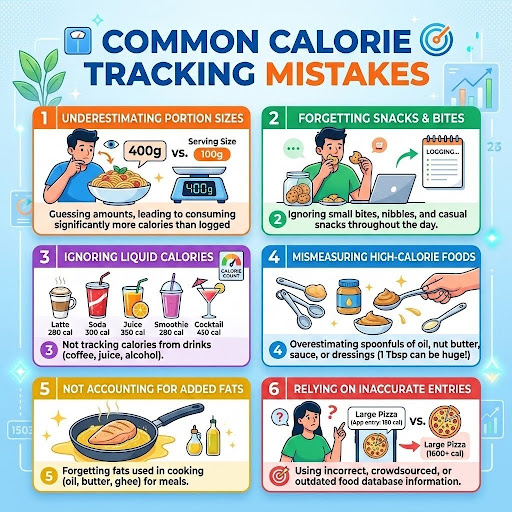
The biggest mistakes are usually small. That’s what makes them hard to notice.
Portions are a big one. Most people underestimate them.
Especially foods like rice, nuts, oils, and desserts.
Liquid calories get missed too. Sugary coffee. Juices. Alcohol. Even milk-heavy chai.
Another mistake is overestimating exercise.
People often assume workouts burn more than they actually do. That creates a false “room” for extra eating.
Weekends are another common blind spot. Tracking all week and then becoming careless for two days can undo more than people realize.
And then there’s eating too little.
This surprises people. But going too low often increases cravings, lowers energy, and makes adherence harder.
Most calorie mistakes are not dramatic. They’re just easy to miss.
And that’s where food quality becomes useful.
What Makes Calorie Tracking Work Better
Not all calories feel the same.
500 calories of protein, fibre, and whole foods usually feel very different from 500 calories of ultra-processed snacks.
Protein helps preserve muscle and improves fullness. Fibre slows digestion and improves satiety.
Higher-volume foods (fruits, vegetables, potatoes, soups) can help you feel fuller for fewer calories.
This makes a deficit easier to tolerate.
That’s important. Because the easier your meals keep you full, the easier your deficit becomes.
Simple meals also help as less complexity often means less tracking stress.
And this leads to one of the most common questions:
Can you technically eat anything as long as it fits your calories?
Can You Eat Anything If You’re Counting Calories?
Technically, for fat loss: calories matter most.
But that doesn’t mean food quality stops mattering. Because calories affect body weight.
Food quality affects energy, recovery, digestion, hunger, and health.
That’s a big difference. This is where the 80/20 idea works well.
Around 80% of intake comes from whole, nutrient-dense foods. The remaining 20% with flexibility.
That leaves room for treats. Meals out. Social events.
Without feeling trapped.
Calories influence fat loss but food quality influences everything else.
And when your intake is aligned properly, progress usually starts becoming visible.
Signs Your Calorie Deficit Is Actually Working
A lot of people expect fast change. But real progress is often quieter than expected.
The scale trending down slowly. Measurements changing. Clothes fitting differently. Energy staying stable. Hunger being manageable.
Strength mostly holding steady.
These are good signs.
Progress is not always dramatic. And it’s not always linear.
Some weeks move faster. Some slower.
That’s normal. But eventually, even well-set deficits need adjustments.
When It’s Time to Adjust Your Calories
This usually happens when progress slows for a few weeks despite consistency.
That doesn’t always mean something is wrong. It may simply mean your body has adapted.
As body weight drops, calorie needs often drop too. The calories that created progress before may now only maintain it.
Sometimes activity changes too.
More movement. Less movement. Harder training. Less sleep. Higher stress.
All of these affect energy needs.
The calories that got you here may not be the calories that get you further. And that’s why adjustments are normal.
Not failure.
How to Make Calorie Tracking Sustainable Without Obsessing Over It
The goal is not to track every gram forever. That’s important.
Tracking is a tool. Not a permanent lifestyle requirement. Over time, most people start recognizing patterns.
They learn portions better. They understand their habits better. They stop needing perfect precision.
And that’s the point.
Better awareness. Not lifelong dependence.Perfection also needs to go.
One untracked meal does not ruin anything. Neither does one higher-calorie day.
Zoom out. Look at the week.
The goal of tracking is not lifelong dependence.
It’s better awareness. And that’s the part most people miss.
Calorie Tracking Is Not About Restriction. It’s About Awareness
That’s the biggest shift. Calories are not there to control you.
They’re there to inform you. They help explain why things are moving, or not moving.
They turn confusion into clarity. And when used well, they remove a lot of the guesswork that makes weight loss frustrating.
Calorie tracking works best when it stops feeling like control and starts feeling like understanding.
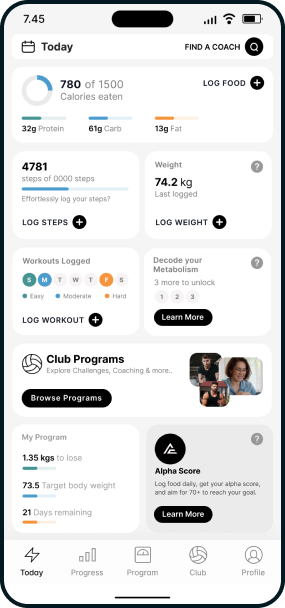
And if you want help making that process easier; from food logging to calorie awareness to building sustainable habits, tools like Alpha Coach can help simplify that process without making it feel overwhelming.
Frequently Asked Questions
Do I need to count calories to lose weight?
No. People have lost weight long before calorie-tracking apps existed. But counting calories can be one of the fastest ways to understand where your intake actually stands. It helps turn vague habits into measurable ones, which can make fat loss more predictable and easier to adjust.
How many calories should I eat to lose fat?
There isn’t one fixed number that works for everyone. Your calorie needs depend on your body size, activity level, muscle mass, and goal. The best place to start is your maintenance intake, then create a moderate deficit from there. The goal is to lose fat without making hunger, energy, or adherence unmanageable.
Are calorie calculators accurate?
They’re useful, but they’re not exact. A calorie calculator gives you an estimate based on formulas and averages. Think of it as a starting point, not a final answer. Your actual progress, hunger, and energy levels will tell you whether that number needs adjusting.
Can I lose weight without tracking calories?
Yes. Many people do this by improving portion control, food quality, and eating habits. But tracking can make the process clearer, especially if progress feels inconsistent or you’re unsure where extra calories may be coming from.
Should I count calories forever?
Not necessarily, but there’s nothing wrong with continuing if it helps you stay aware and consistent. For some people, calorie tracking is a short-term learning tool to understand portions and eating patterns. For others, it remains a useful long-term habit, much like budgeting money. The goal isn’t to become obsessive, but to use tracking in a way that supports better decisions. If it keeps you aligned with your goals without creating stress, there’s no real reason to stop.
 0
0












Leave a Reply