
 119 views
Most people think their workout starts the moment they step into the gym. In reality, it starts much earlier, often with what they eat before they train.
That’s one of the biggest reasons why two workouts can feel completely different, even when the program is the same.
Some days, you feel strong, focused, and sharp. The weights move well, your stamina feels good, and everything clicks. On other days, you feel flat from the start. There’s no energy, no rhythm, and halfway through the session you’re already wondering why everything feels harder.
A lot of the time, that difference comes down to food.
For Indian vegetarians, this becomes even more important because pre-workout eating often goes wrong in familiar ways. Sometimes it’s a heavy meal too close to training. Sometimes it’s barely eating at all. And sometimes it’s eating foods that are healthy in general, but poorly timed for exercise.
A stuffed paratha and chai right before squats can feel terrible. So can trying to deadlift on an empty stomach.
The right pre-workout meal can improve performance, focus, stamina, and recovery. And despite what social media often suggests, you don’t need expensive supplements or imported powders to get it right. Indian vegetarian foods can do the job extremely well if they’re structured properly.
Why Your Workout Feels Different Depending on What You Eat Before It
Most people have felt this without fully connecting it to food.
You show up for the same workout, at roughly the same time, but your body feels completely different. Some sessions feel smooth and powerful. Others feel unusually heavy, sluggish, or mentally drained.
That shift often has less to do with motivation than people think.
Training demands available energy. If you haven’t eaten enough beforehand, your body may simply not have enough fuel to perform well. This usually shows up as fatigue, weakness, poor concentration, or that flat feeling where everything feels harder than normal.
On the other hand, eating too much (especially a heavy or oily meal) can create the opposite problem. Instead of feeling energized, you feel full, slow, or uncomfortable because digestion is still doing most of the work.
That’s why pre-workout nutrition matters. It’s not just about avoiding hunger. It’s about creating the right physical conditions for your body to train well.
Sometimes the quality of a session is shaped long before the workout begins.
What a Pre-Workout Meal Actually Does
A pre-workout meal has one main purpose: to prepare your body for the demands of training.
The biggest part of that is energy.
Carbohydrates are especially important here because they help fill glycogen stores, which your body relies on heavily during strength training, high-intensity workouts, and longer sessions. If glycogen is low, performance often drops earlier than expected.
Protein plays a different role. It doesn’t give immediate energy in the same way carbs do, but it helps support muscle during training and contributes to recovery later.
Then there’s hydration, which often gets overlooked. Even mild dehydration can reduce endurance, strength, and focus.
So a good pre-workout meal isn’t about eating as much as possible. It’s about giving your body enough fuel to perform without making digestion a problem.
And for vegetarians, getting that balance right often takes a little more thought.
Why Indian Vegetarians Need to Think About Pre-Workout Nutrition Differently
Indian vegetarian diets are often rich in carbohydrates, which can be useful for training. But that doesn’t automatically make them ideal pre-workout meals.
The issue is usually balance.
A lot of common Indian meals like poha, idli, upma, toast, even parathas can provide energy, but they’re often either too low in protein or too heavy in fat, depending on how they’re prepared.
That really matters.
A bowl of poha may give energy, but on its own, it may not offer enough protein support for someone training regularly. A greasy paratha may provide calories, but it can feel heavy and uncomfortable during movement.
Digestion becomes the biggest factor here.
Indian meals can be fibre-rich, oil-heavy, or spicy, which is great for general eating but not always ideal an hour before training. This is where bloating, acidity, or heaviness often show up.
A lot of vegetarian meals have enough calories, but not always the right structure for performance.
That’s why pre-workout eating for vegetarians needs to be intentional and better organized.
The Three Things Every Good Pre-Workout Meal Needs
A good pre-workout meal doesn’t have to be complicated. In most cases, it comes down to getting three things right: energy, muscle support, and digestion.
The first is carbohydrates.
This is your body’s most accessible fuel source before training. Carbs help top up glycogen stores, which directly affects how much intensity you can bring into a session. If you’re lifting weights, doing high-volume training, or even pushing through a long cardio workout, carbs usually make a noticeable difference.
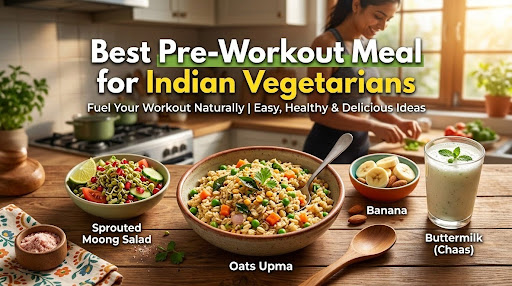
For Indian vegetarians, some of the easiest carb options are bananas, oats, poha, rice, potatoes, or even simple bread.
The second is protein.
You don’t need a huge amount before training, but having some protein can be useful for muscle support, especially if your session is intense or your overall goal is muscle gain. Paneer, tofu, curd, Greek yogurt, milk, or whey are practical options here.
The third (and often the most ignored) is digestion.
This matters more than people realize.
A meal can be nutritionally excellent and still feel terrible if it sits too heavy. High-fat foods, oily curries, deep-fried snacks, or very spicy meals often slow digestion and can make training uncomfortable.
A good pre-workout meal should leave you feeling ready to move, not like you’re waiting for your stomach to settle.
And that’s where timing becomes important.
When Should You Eat Before a Workout?
The best meal can feel wrong if the timing is off.
That’s because your body handles food differently depending on how close you are to training. The closer the workout, the simpler and lighter the meal usually needs to be.
If you have 2 to 3 hours before training, you have enough time for a proper meal. This is where you can comfortably eat something balanced, like rice with tofu and curd, oats cooked in milk with banana, or a paneer sandwich with fruit. These meals give both energy and protein, while allowing enough time for digestion.
If you have 60 to 90 minutes, the meal usually needs to be lighter. This is where foods like poha with curd, Greek yogurt with fruit, or banana with peanut butter work well. They’re easier to digest and still provide enough fuel.
And if you only have 20 to 30 minutes, simplicity matters the most. This is usually where the best pre-workout snack becomes more useful than a full meal. A banana, a few dates, black coffee, or coconut water can often be enough.
The closer you are to the workout, the less your body wants complexity. That’s the easiest way to think about it.
The Best Indian Vegetarian Pre-Workout Meals Based on Timing

There isn’t one single “best” pre-workout meal for everyone. What works best often depends on how much time you have before training.
If you have enough time for a proper meal, options like poha with curd, oats with milk and banana, paneer sandwiches, or rice with tofu work extremely well. These meals provide a strong mix of carbohydrates and protein without being overly complicated.
If you’re working with less time, lighter meals often make more sense. Greek yogurt with fruit, a smoothie made with banana and oats, or a quick peanut butter sandwich are all practical.
And when time is tight, simple snacks usually work best.
This is where the best pre workout snacks are often the most effective:
banana and coffee, dates, roasted chana, or coconut water.
The best pre-workout meal is rarely the one with the most ingredients. It’s usually the one that digests well, gives you energy, and fits into your routine consistently.
Best Pre-Workout Meals for Different Goals
Your training goal changes what makes the most sense before a workout.
If your goal is fat loss, the focus is usually on getting enough fuel without pushing calories too high. Something like black coffee with banana, Greek yogurt, or fruit with whey can work well because it gives energy without becoming too heavy.
If the goal is muscle gain, a pre-workout meal for muscle gain usually needs more total energy. This often means more carbs and enough protein to support harder training. Meals like oats with whey and peanut butter, paneer sandwiches with fruit, or rice with tofu and curd work well here because they support both training intensity and overall calorie intake.
For endurance training, longer-lasting carbs often matter more. Oats, sweet potato, poha, and fruits tend to work better because they provide steadier energy.
And for early morning workouts, a full meal often feels impractical. This is where the best pre-workout snack usually makes more sense: something light, quick, and easy to digest.
What works before a fat-loss workout can look very different from what works before a muscle-gain session.
Can You Train on an Empty Stomach?
The short answer is yes. But whether it’s a good idea depends on the workout.
For lighter sessions like walking, mobility work, or easy cardio, fasted training is usually fine for most people.
But once intensity goes up, things change.
Strength training, intervals, or longer sessions usually benefit from some fuel beforehand. Not because fasted training is harmful, but because performance often improves when energy is available.
That’s the bigger point.
Training while you are fasting is not automatically bad. It’s just not ideal for every goal.
If you’re training for fat loss but your workout quality drops badly when fasted, that trade-off may not be worth it.
Even something small (a banana, dates, or coffee) can often improve the session.
And sometimes that’s all you need.
Foods That Usually Don’t Work Well Before Training
Not all food is bad before a workout, but some foods are simply harder to train on.
The problem is rarely the food itself. It’s what the food asks from your digestion when your body should be focused on movement.
Fried foods are one of the most common examples.
Things like samosas, pakoras, or anything deep-fried may taste great, but they usually sit heavy and slow digestion down.
The same goes for creamy curries or rich gravies. They’re often high in fat, which can delay digestion and leave you feeling sluggish.
Very spicy meals can also be unpredictable. For some people, they’re fine. For others, they can lead to acidity, discomfort, or that uncomfortable heavy feeling during training.
Even high-fibre foods can be tricky if eaten too close to a workout. Fibre is excellent for health, but right before exercise, too much of it can increase bloating.
And then there are sugar-heavy foods. A quick sugar spike may feel like energy, but it can also crash quickly, especially if there’s no other structure around it.
The issue isn’t whether these foods are “good” or “bad.” It’s simply that they’re often poorly timed for performance.
The Most Common Pre-Workout Eating Mistakes
Most pre-workout mistakes are simple, but they affect performance more than people realize.
One of the biggest is eating too much. People assume more food means more energy, but if the meal is too large or too close to training, it usually backfires. Instead of feeling fuelled, you feel slow.
The opposite mistake happens too, eating too little.
This is especially common with early morning workouts, where people rely on just coffee or nothing at all. That may work occasionally, but over time it can hurt training quality.
Skipping carbs is another common mistake, especially among people trying to lose fat. But carbs are often the main thing helping you perform.
Without them, workouts can feel flat.
Hydration is another one. People focus on food and forget water, even though dehydration can affect endurance, focus, and strength.
And then there’s over-reliance on supplements. A pre-workout powder cannot fix poor meal timing. It can’t fix under-fuelling either.
Good food can still feel like bad fuel if the timing and quantity are wrong. That’s why the basics matter first.
How to Figure Out What Works Best for You
This is where most people overcomplicate things. They look for the perfect pre-workout meal, when in reality the better question is:
What works best for my body?
Because even good recommendations won’t feel the same for everyone.
Some people digest oats easily and feel great. Others feel too full.
Some feel sharp after banana and coffee. Others feel hungry again in 20 minutes. That’s normal.
Your digestion, workout style, training time, and even stress levels all affect what feels best.
This is why experimentation matters. Pay attention to how you feel:
Do you feel energized? Heavy? Hungry? Focused? Flat?
The best pre-workout meal is usually discovered, not copied.
And once you find something that works consistently, it becomes much easier to build your routine around it.
The Best Pre-Workout Meal Is the One You Can Train Well On
That’s the real takeaway. It will not be the most expensive meal. Nor will it be one with the most ingredients. And probably not the one your favourite fitness creator swears by.
The best pre workout meal is the one that gives you enough energy, feels light enough to digest, and supports the kind of training you’re doing.
That might be oats and whey. It might be poha and curd. It might just be a banana and coffee.
What matters is whether it helps you perform.
Because pre-workout nutrition isn’t about eating perfectly. It’s about eating in a way that makes training feel better.
And when training feels better, consistency usually follows.
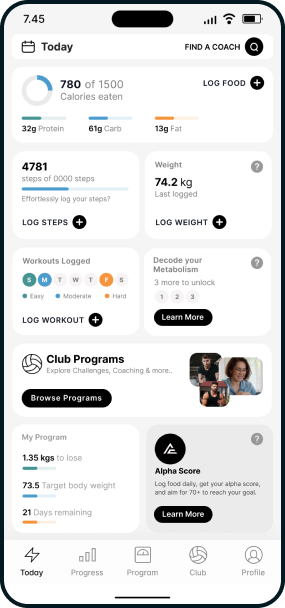
If you want to understand your meals better, track your protein, or build your nutrition around your workouts with more structure, tools like Alpha Coach can make that process much easier.
Frequently Asked Questions
What is the best pre-workout meal for vegetarians?
The best pre-workout meal for vegetarians is usually one that combines carbohydrates for energy with some protein for muscle support, while still being easy to digest. For Indian vegetarians, this could be something as simple as oats with banana, poha with curd, paneer on toast, or a smoothie with whey. What works best depends on your training time and how much time you have before the workout.
What should I eat 30 minutes before the gym?
If you only have 30 minutes, keep it simple.
This is where a best pre-workout snack works better than a full meal because digestion time is limited. Foods like bananas, dates, black coffee, or coconut water are practical because they provide quick energy without making you feel heavy.
The goal here is not fullness. It’s quick, usable fuel.
Is banana a good pre workout food?
Yes, for most people it’s one of the easiest and most effective options. Bananas are rich in carbohydrates, digest quickly, and are convenient. That makes them especially useful before early morning workouts or when you don’t have time for a full meal.
They also pair well with coffee, curd, or peanut butter if you want slightly more structure.
Can I workout on an empty stomach?
You can, but it depends on what you’re doing. For low-intensity sessions like walking or light cardio, fasted training is usually manageable. But for strength training, intense cardio, or longer sessions, eating something beforehand often improves performance.
Even a small snack can make a noticeable difference. The question isn’t whether you can train in fasting state. It’s whether you train better that way.
Is coffee good before exercise?
For many people, yes. Coffee can improve alertness, focus, and perceived energy during training because of its caffeine content. It often works especially well when paired with a small carb source like a banana or dates.
But it depends on tolerance. If coffee makes you jittery, anxious, or affects your stomach, it may not be the best option for you.
What is the best pre-workout meal for muscle gain?
A strong pre-workout meal for muscle gain usually includes both carbohydrates and protein, with enough total calories to support hard training.
Meals like oats with whey and peanut butter, paneer sandwiches with fruit, or rice with tofu and curd work well because they help improve training output while supporting your daily calorie intake.
That’s important because muscle gain depends on the full day’s intake, not just the meal before training.
 0
0






Leave a Reply