
 101 views
You’ve Probably Been Choosing Workout Splits Backwards
You’ve decided it’s time to get serious about fitness. So you start researching workout routines.
One article says full-body workouts are best. A fitness influencer swears by ‘Push-Pull-Legs’. Someone at the gym insists you need a dedicated chest day, back day, shoulder day, and arm day to build muscle properly.
A few days later, you’re more confused than when you started.
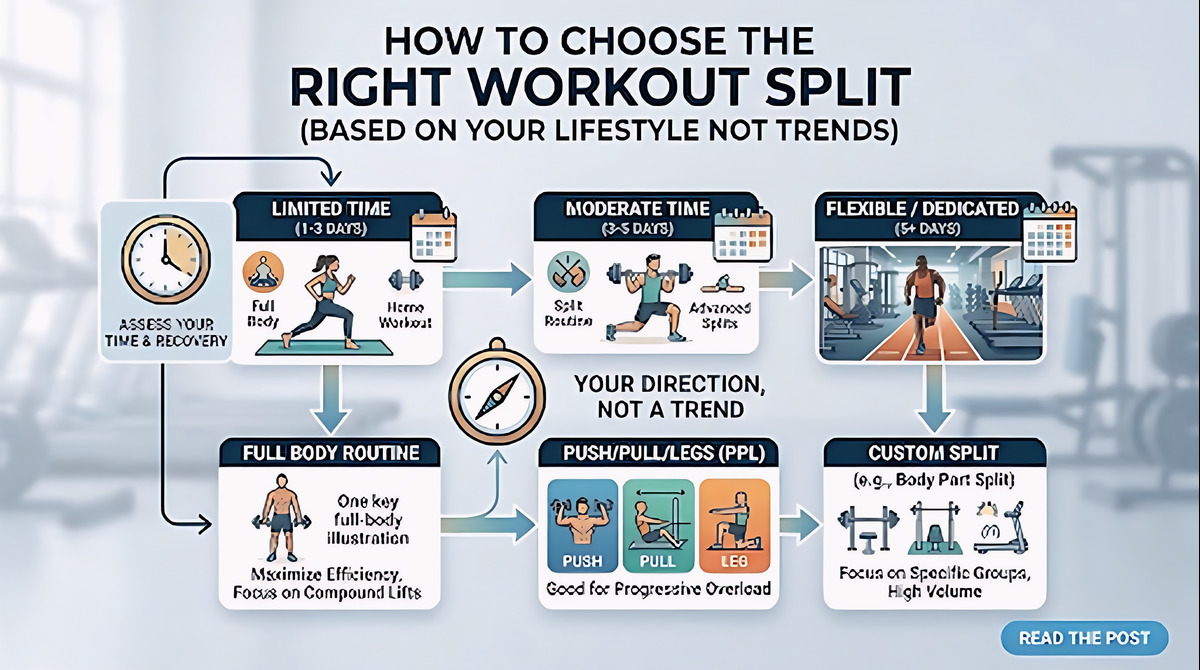
The best workout split isn’t the one used by a bodybuilder, fitness influencer, or professional athlete. It’s the one that fits your schedule, recovery capacity, responsibilities, and ability to stay consistent.
A parent with two young children, a corporate professional working long hours, and a college student on summer break may all have different “best” workout splits even if their fitness goals are similar.
This is why so many people fail with otherwise good training programs. They choose a routine that looks impressive on paper but falls apart when real life gets involved.
The truth is that consistency drives results far more than complexity. A simple workout split you can follow for the next six months will almost always outperform an advanced routine you abandon after three weeks.
Before choosing a workout split, stop asking:
“What’s the best workout split?”
Start asking:
“What’s the best workout split for my life?”
Quick Answer: Which Workout Split Is Right for You?
If you’re looking for the fastest answer, start here.
| Your Situation | Best Workout Split |
| 2–3 workouts per week | Full Body |
| 4 workouts per week | Upper-Lower |
| 5 workouts per week | Push-Pull-Legs |
| 5–6 workouts per week and advanced | Body Part Split |
| Unpredictable schedule | Rotating Full Body |
The important thing to understand is that none of these splits are inherently superior.
When weekly training volume and effort are appropriate, several workout splits can produce excellent results. What usually separates successful trainees from unsuccessful ones isn’t the split itself; it’s their ability to stick to it consistently.
What Is a Workout Split (And Why Does It Matter)?
A workout split is simply the way you organize your training across the week.
Rather than training every muscle group randomly, a workout split creates structure by deciding what you’ll train and when you’ll train it.
For example:
- Full-body training works the entire body in each session.
- Upper-lower training separates upper-body and lower-body workouts.
- Push-pull-legs groups muscles based on movement patterns.
- Body-part splits dedicate individual days to specific muscle groups.
At first glance, this may seem like a minor detail.
In reality, workout splits exist for three important reasons.
1. They Help Manage Recovery
Every workout creates fatigue.
Your muscles, nervous system, connective tissues, and energy stores all need time to recover before performing at their best again.
A structured workout split helps distribute training stress across the week so that recovery can keep pace with training.
2. They Improve Training Quality
Trying to train every muscle group with maximum volume in a single workout quickly becomes impractical.
As fatigue accumulates, exercise quality often drops.
Workout splits allow you to spread training across multiple sessions so you can maintain better performance throughout the week.
3. They Make Consistency Easier
One of the most overlooked benefits of a workout split is predictability.
When you know exactly what you’re doing each day, you remove decision fatigue.
Instead of walking into the gym wondering what to train, you already have a plan.
And in fitness, structure almost always beats guesswork.
The 5 Questions You Must Answer Before Choosing Any Workout Split

Many people choose a workout split because someone else recommended it.
A better approach is to evaluate your own situation first.
These five questions will usually tell you exactly which workout split makes the most sense.
1. How Many Days Can You Realistically Train?
Notice the word realistically.
Not your ideal week.
Not your most motivated week.
Not the week where nothing goes wrong.
Your normal week.
This is the single most important factor when choosing a workout split.
Many people select a five- or six-day training plan because they feel motivated at the start. Then work deadlines, family commitments, travel, illness, or simple fatigue get in the way.
A month later they’re completing half the workouts and wondering why the program isn’t working. If you can reliably train three days every week, a three-day workout split is often a better choice than a six-day routine you only complete occasionally.
The most effective workout split is usually the one you can still follow during a busy week.
2. What Is Your Main Goal?
Different goals may influence how you structure your training.
If your goal is muscle gain, you’ll want enough weekly training volume and progressive overload to stimulate growth.
If your goal is fat loss, consistency and adherence matter far more than choosing a specific split. A calorie deficit and regular resistance training are what drive results.
If your goal is general health and fitness, almost any well-structured split can work provided you perform it consistently.
The mistake many people make is assuming there is a special workout split for fat loss and another for muscle gain.
In reality, most effective resistance-training splits can support both goals when paired with the right nutrition and recovery habits.
3. What’s Your Training Experience?
Beginners often benefit from simpler workout structures.
Why? Because almost everything works when you’re new.
Your body responds quickly to resistance training, which means you don’t need highly specialized programming to see progress.
Intermediate trainees may benefit from slightly higher training volumes and more structured progression.
Advanced lifters often require greater precision because gains come more slowly and training demands increase.
As a general rule, the more experienced you become, the more important programming details become.
For beginners, consistency still does most of the heavy lifting.
4. How Good Is Your Recovery?
Recovery determines how much training you can effectively handle.
Unfortunately, most people focus entirely on workouts and ignore recovery.
Your ability to recover is influenced by:
- Sleep quality
- Stress levels
- Nutrition
- Work demands
- Travel frequency
- Family responsibilities
Someone sleeping eight hours per night with low stress can often recover from more training than someone sleeping five hours and working twelve-hour shifts.
The best workout split isn’t just one you can complete.
It’s one you can recover from.
5. Is Your Schedule Predictable?
This factor is rarely discussed but often determines long-term success.
Some people have highly structured routines. Others don’t.
A fixed Monday-to-Friday workout split works well when your weekly schedule rarely changes.
But if you travel frequently, work rotating shifts, or have unpredictable commitments, you may need a more flexible training structure.
In those situations, choosing a workout split designed around flexibility often leads to better adherence and better results.
Because a perfect workout plan that doesn’t fit your life is still the wrong plan.
The Best Workout Splits Based on Real-Life Schedules
One of the biggest misconceptions in fitness is that certain workout splits are inherently superior to others.
In reality, most popular workout splits can build muscle, improve strength, and support long-term fitness when applied correctly.
The difference isn’t usually the split itself.
It’s whether that split fits your lifestyle well enough to be followed consistently.
A workout plan only works when it gets done.
If You Can Only Train 2–3 Days Per Week
Best Choice: Full-Body Workout Split
If your schedule is packed with work, family responsibilities, commuting, travel, or unpredictable commitments, full-body training is often your best option.
A full-body split trains all major muscle groups during each workout.
A simple example might look like:
- Monday: Full Body
- Wednesday: Full Body
- Friday: Full Body
At first glance, some people assume this is a beginner-only approach. That’s a mistake.
Many experienced lifters continue using full-body programs because they’re efficient, flexible, and effective.
Research suggests that when overall training volume is matched, training a muscle multiple times throughout the week can be just as effective for muscle growth as more specialized splits. The advantage of full-body training is that it naturally provides this frequency without requiring five or six gym visits.
Full-body training works particularly well because missing one workout doesn’t completely disrupt your week.
If you miss a Friday session, you’ve still trained your entire body twice.
Compare that with missing a dedicated leg day on a body-part split and not training legs again until the following week.
Best for:
- Busy professionals
- Parents
- Beginners
- Frequent travellers
- People restarting fitness after a long break
Potential downside:
Sessions can feel slightly longer because multiple muscle groups are trained in a single workout.
For most busy people, however, this trade-off is well worth it.
If You Can Consistently Train 4 Days Per Week
Best Choice: Upper-Lower Split
If there is one workout split that sits comfortably in the middle of almost every fitness goal, it is the upper-lower split.
Many coaches consider this the sweet spot between efficiency and specialization.
Instead of training the entire body every session, you divide training into upper-body and lower-body days.
Example:
- Monday: Upper Body
- Tuesday: Lower Body
- Thursday: Upper Body
- Friday: Lower Body
This structure allows each muscle group to be trained twice per week while giving adequate recovery between sessions.
For many people, this balance is ideal.
Workouts are generally shorter than full-body sessions because fewer muscle groups are trained at once. At the same time, training frequency remains high enough to support strength and muscle growth.
The upper-lower split also tends to fit naturally into a traditional work week.
You can train four days, recover on weekends if needed, and still maintain a social life.
Best for:
- Intermediate lifters
- Muscle-building goals
- Busy people with predictable schedules
- Those wanting more gym time without living in the gym
Potential downside:
Requires a reasonably consistent weekly schedule. Missing multiple sessions can make the week feel slightly unbalanced.
For many recreational lifters, however, this is arguably the most practical long-term workout split available.
If You Can Train 5 Days Per Week
Best Choice: Push-Pull-Legs (PPL)
Few workout splits have become as popular as Push-Pull-Legs.
For good reason.
Instead of organizing workouts by muscle groups, PPL organizes them by movement patterns.
Push Day
- Chest
- Shoulders
- Triceps
Pull Day
- Back
- Biceps
Leg Day
- Quadriceps
- Hamstrings
- Glutes
- Calves
A typical schedule might look like:
- Monday: Push
- Tuesday: Pull
- Wednesday: Legs
- Friday: Push
- Saturday: Pull
This approach allows more training volume per muscle group while keeping individual sessions focused.
For people who genuinely enjoy training and can consistently make five weekly sessions happen, PPL can be an excellent option.
However, this is where many people become overly ambitious.
A split isn’t effective because it looks advanced.
It’s effective because it matches your lifestyle.
Someone who reliably trains four days every week will often make better progress than someone attempting a six-day PPL routine and repeatedly missing workouts.
Best for:
- Intermediate lifters
- Muscle-building focused trainees
- Fitness enthusiasts
- People who enjoy frequent gym sessions
Potential downside:
Less forgiving when life gets busy.
Miss a workout and the entire rotation can become difficult to manage.
If You Train 5–6 Days Per Week and Have Years of Experience
Best Choice: Body-Part Split
The traditional body-part split, often called a “bro split,” has been a bodybuilding staple for decades.
A typical schedule might look like:
- Monday: Chest
- Tuesday: Back
- Wednesday: Legs
- Thursday: Shoulders
- Friday: Arms
This approach allows a large amount of training volume to be directed toward specific muscle groups during each session.
For advanced trainees, that can be useful.
The problem is that many beginners copy bodybuilders without considering the context.
Professional bodybuilders often train as a central part of their lifestyle. Their recovery, experience, exercise technique, nutrition habits, and training history are very different from those of the average gym-goer.
For most people, dedicating an entire day to biceps or chest simply isn’t necessary.
Can body-part splits build muscle?
Absolutely. Are they automatically better than full-body or upper-lower training?
Not necessarily.
The biggest advantage of body-part training is specialization. The biggest disadvantage is reduced flexibility.
Miss a workout and an entire muscle group may go untrained that week.
Best for:
- Advanced lifters
- Physique-focused goals
- Individuals who enjoy longer gym routines
- People with excellent recovery habits
If Life Is Unpredictable
Best Choice: Rotating Full-Body Training
Some people cannot commit to fixed training days.
Shift workers. Doctors. Business travellers. Entrepreneurs.
Parents with constantly changing schedules.
For these individuals, assigning workouts to specific weekdays often creates unnecessary stress.
Instead, use a rotating approach.
Rather than saying:
- Monday = Workout A
- Wednesday = Workout B
- Friday = Workout C
You simply perform the next workout whenever you’re available.
For example:
Workout A → Workout B → Workout C → Repeat
This system removes the guilt that many people feel when they miss a scheduled workout.
You aren’t falling behind. You’re simply continuing the sequence.
For people with unpredictable lifestyles, this flexibility often produces better long-term consistency than rigid schedules ever could.
Full Body vs Upper-Lower vs Push-Pull-Legs
No workout split automatically wins. Each has strengths and weaknesses.
| Factor | Full Body | Upper-Lower | Push-Pull-Legs |
| Time Commitment | Low | Moderate | High |
| Weekly Gym Visits | 2–3 | 4 | 5+ |
| Beginner Friendly | Excellent | Very Good | Moderate |
| Recovery Demand | Low | Moderate | Higher |
| Flexibility | Excellent | Good | Moderate |
| Muscle Gain Potential | High | High | High |
| Best For | Busy lifestyles | Most lifters | Enthusiasts |
The takeaway is simple. The best workout split is rarely the one with the most training days.
It’s the one that allows you to consistently accumulate quality training week after week.
The Most Common Workout Split Mistakes
Choosing the right workout split is important. Avoiding the wrong decisions is equally important.
Many people don’t struggle because their split is ineffective. They struggle because they make a few predictable mistakes that quietly undermine progress.
Choosing a Split Because It’s Trending
Fitness trends change constantly.
One year everyone is promoting Push-Pull-Legs. The next year it’s high-frequency full-body training.
The problem is that trends don’t know your schedule.
A workout split that works brilliantly for a fitness creator training six days per week may be completely unsuitable for someone balancing work, family, and other responsibilities.
Choose a workout split based on your lifestyle, not someone else’s.
Overestimating Your Available Time
Motivation often creates unrealistic expectations.
You feel excited, choose a six-day routine, buy new gym clothes, and imagine you’ll never miss a workout.
Then reality arrives.
Late meetings. Travel. Family commitments. Poor sleep.
Suddenly six workouts become three. A simpler plan you can consistently follow will almost always outperform an ambitious plan you constantly fall behind on.
Thinking More Days Automatically Means Better Results
Many people assume that training six days per week must be better than training three.
Fitness doesn’t work that way. Results are influenced by factors such as training quality, recovery, nutrition, progressive overload, and consistency.
Three well-executed workouts are usually more productive than six rushed or poorly recovered sessions.
Program Hopping
One of the fastest ways to stall progress is constantly switching between workout splits.
Many trainees never stay with a program long enough to see meaningful results.
They spend a few weeks doing full-body training, then switch to PPL, then try a body-part split after seeing a YouTube video.
Muscle and strength adaptations take time.
Instead of searching for the perfect split every month, focus on improving performance within the split you’re already following.
How Do You Know Your Workout Split Is Working?
Most people evaluate their workout split using the wrong metrics.
After 1 or 2, they ask:
“Am I sore enough?” “Am I sweating more?” “Does this feel hard enough?”
Those aren’t particularly useful indicators. A good workout split should be judged by what happens over months, not days.
You’re Consistently Completing Workouts
The best sign that you’ve chosen the right split is simple: you’re actually following it.
Missing the occasional workout is normal.
Regularly completing 80–90% of your planned sessions is a strong sign that the split fits your lifestyle.
Your Performance Is Improving
Over time, you should notice improvements such as:
- Lifting heavier weights
- Performing more repetitions
- Better exercise technique
- Increased work capacity
Progressive overload remains one of the most reliable indicators that training is moving in the right direction.
Recovery Feels Manageable
You shouldn’t feel completely exhausted all the time.
A productive workout split challenges you while still allowing recovery between sessions.
Constant fatigue, declining performance, and persistent soreness can all indicate that training demands exceed recovery capacity.
Your Body Composition Is Changing
The scale tells only part of the story.
A successful workout split may lead to:
- Increased muscle mass
- Reduced body fat
- Improved measurements
- Better physical performance
- More energy throughout the day
Sometimes progress appears in the gym before it becomes obvious in the mirror. That’s normal.
Conclusion
A workout routine that survives busy work weeks, family commitments, travel schedules, and low-motivation days will almost always outperform a more advanced routine that looks impressive but rarely gets completed.
Instead of asking which workout split is best on paper, ask which one you’ll still be following six months from now.
That’s usually the right answer.
And if you’d like more structure along the way, Alpha Coach can help you track workouts, monitor progress, and build fitness habits around your real-life schedule. Because long-term results come from consistency, not constantly searching for the next perfect program.
Frequently Asked Questions
What Is the Best Workout Split for Muscle Gain?
There isn’t one universally superior workout split for building muscle.
Research suggests that total training volume, effort, and consistency are generally more important than the specific split itself.
For most people, full-body, upper-lower, and Push-Pull-Legs can all produce excellent muscle-building results when performed consistently.
What Is the Best Workout Split for Fat Loss?
Fat loss is primarily driven by maintaining a calorie deficit while preserving muscle mass through resistance training.
The best workout split for fat loss is therefore the one you can perform consistently while supporting recovery and adherence.
For many busy individuals, full-body or upper-lower training works extremely well.
Is Three Days Per Week Enough to Build Muscle?
Absolutely. Many people build significant muscle and strength with three well-structured resistance-training sessions per week.
Consistency, progressive overload, adequate protein intake, and recovery matter far more than simply adding extra gym days.
Is Full-Body Training Effective?
Yes. Full-body training is one of the most efficient workout structures available.
It allows frequent muscle stimulation, flexible scheduling, and excellent recovery management, making it suitable for beginners and experienced lifters alike.
Is Push-Pull-Legs Better Than Upper-Lower?
Neither split is universally better. Push-Pull-Legs generally allows more specialization and training volume, while upper-lower often provides a better balance of flexibility, recovery, and practicality.
The better choice depends on your schedule and preferences.
Can Women Follow the Same Workout Splits as Men?
Yes. Workout split selection should be based on training goals, recovery capacity, experience level, and schedule, not gender.
The principles of strength training and muscle development remain fundamentally the same.
How Often Should I Change My Workout Split?
Most people change workout splits far too often. If you’re making progress, recovering well, and staying consistent, there is usually no reason to change.
Consider adjusting your split when your goals, schedule, or recovery demands change significantly.
What Should I Do If I Miss a Workout?
Don’t panic. Don’t restart the entire program.
And don’t try to cram multiple missed sessions into one day. Simply continue with your next planned workout and return to your normal schedule.
Long-term consistency matters far more than any single missed session.
 0
0








Leave a Reply