
 23 views
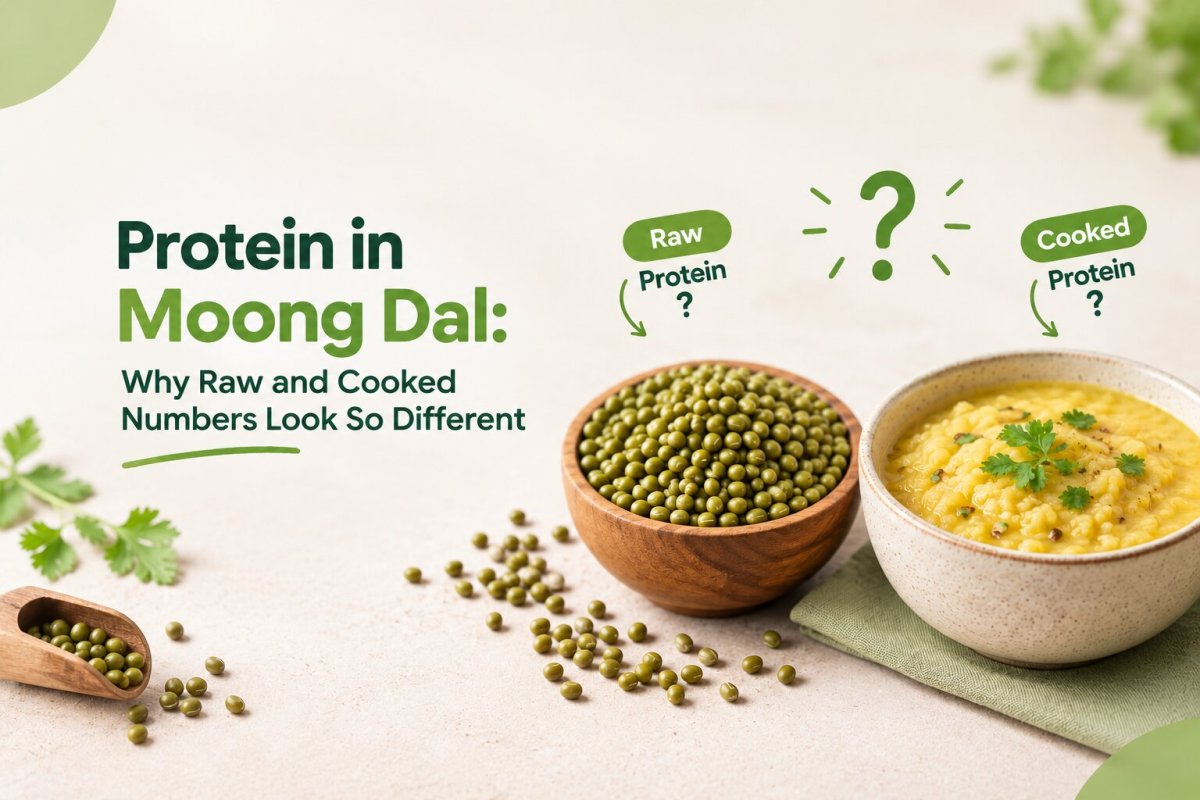
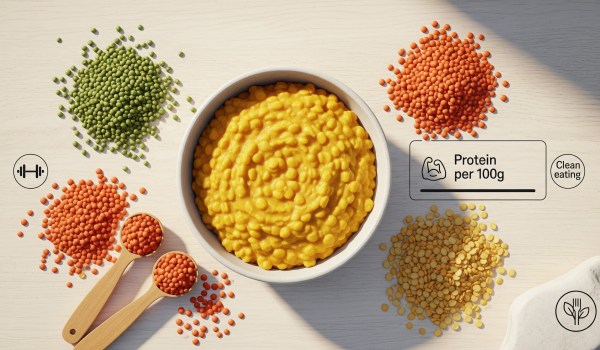
Look up protein in moong dal per 100g and you may see around 24g. Look up 100g of cooked moong dal and the number can look dramatically lower. Nothing mysterious happened to the protein in the pressure cooker.
The first number refers to dry dal. The second includes all the water absorbed during cooking. This confusion isn’t unique to moong. It applies to protein in dal per 100g generally, across toor, chana, masoor and urad too. But moong is where people notice it most, because it appears on so many plates in so many forms.
100 gm Moong Dal Protein: The Starting Number
Indian Food Composition Tables list green gram dal at about 23.9g protein and 326 calories per 100g dry weight. So 100 gm moong dal protein works out to roughly 24g, but that’s dry weight, not what lands in your bowl.
| Dry Moong Dal | Approx. Protein |
| 25 g | ~6 g |
| 50 g | ~12 g |
| 75 g | ~18 g |
| 100 g | ~24 g |
For home cooking, these dry-weight numbers are far easier to use than working backwards from a bowl of cooked dal.
Moong Dal Calories and Nutrition Facts Per 100g
Protein isn’t the only number worth knowing. Moong dal calories per 100g dry weight are roughly 326, and carbohydrate makes up most of the rest.
| Nutrient (per 100g dry moong dal) | Approx. Value |
| Calories | ~326 kcal |
| Protein | ~24 g |
| Carbohydrate | ~55-60 g |
| Fat | ~1 g |
So while moong dal protein is strong for a pulse, carbohydrate still makes up the bulk of the dry weight. Fibre varies a lot between whole green moong (around 16g per 100g) and skinned split dal (much lower), so check the pack if fibre matters to you.
Green, Yellow and Split Moong Dal Protein Per 100g
Whole green moong (skin-on), split green moong (chilka) and skinned yellow moong dal all come from the same bean. Green moong dal protein per 100g therefore sits in a similar range to yellow or split moong dal protein, roughly 23-24g per 100g dry.
The practical differences are elsewhere:
- Whole green moong: more fibre, longer cooking time
- Split with skin (chilka): a middle ground
- Yellow moong dal (skinned): cooks fastest and is the easiest to digest
Sprouted moong is different. Sprouting adds a lot of water, so protein per 100g of sprouts is far lower than dry dal (often only around 3-4g). This is the same dilution effect as cooking, and it’s why dry weight is the cleanest way to compare.
Why Cooked Moong Dal Protein Looks Lower
Take 50g dry dal. It contains roughly 12g protein. Add water and cook it, and the finished dal may weigh several times more, depending on how thick or watery you make it.
The protein didn’t disappear. You simply added water. That’s why cooked moong dal protein per 100g always reads lower than the dry figure. Plain boiled moong is often around 7g per 100g, while a thin, watery dal can be only 2-4g per 100g.
| Form | Approx. protein per 100g |
| Dry moong dal | ~24 g |
| Thick cooked moong | ~7 g |
| Thin, watery dal | ~2-4 g |
Two people can both say they ate “one bowl of dal” and have eaten very different amounts of actual dal.
How Much Protein Is in One Bowl of Moong Dal?
There’s no honest single answer unless we know how much dry dal went into the serving.
If your portion contains the equivalent of 40g dry moong dal, you’re getting roughly 9-10g protein. At 50g dry, it’s around 12g. A larger 75g dry portion gets you close to 18g.
This is more useful than assuming every katori in India is the same size, or that every household cooks dal to the same thickness.
Moong Dal vs Toor Dal and Other Dals
Searching protein in dal per 100g shows that most common dals fall in a similar band of roughly 22-25g per 100g dry (moong, toor, chana, masoor, urad). So moong dal vs toor dal protein is rarely a deciding factor. Choose on digestibility, taste and what suits your meals, and check your pack label for exact figures.
Moong Dal, Khichdi and Chilla Are Not the Same Meal
Moong appears in several forms, and the recipe changes what reaches your plate.
A bowl of moong dal may have a high proportion of dal. Khichdi also contains rice, so protein depends on the dal-to-rice ratio. Moong dal chilla can use a more concentrated amount of dal per serving.
“Made from moong” tells you the ingredient. It doesn’t tell you the final macros.
Is Moong Dal High in Protein?
For a pulse, yes, it has a strong protein number. But dry moong dal also carries substantial carbohydrate and calories alongside that protein.
It’s better to call it an important protein contributor in an Indian vegetarian diet than to expect one bowl to complete your day’s target. Dal with curd, paneer, tofu or eggs makes a higher-protein meal much easier. See our protein in tofu per 100g guide or protein in paneer per 100g guide for pairing ideas.
Moong Dal Benefits Beyond Protein
Beyond moong dal nutrition numbers, its appeal is practical. It’s easy to digest compared with heavier pulses, provides fibre that helps with fullness, is low in fat, and works in many forms: dal, khichdi, chilla, soups or sprouts.
Moong Dal for Weight Loss
Moong dal fits comfortably into a weight-loss diet. It brings protein and fibre, and a simple dal can be filling.
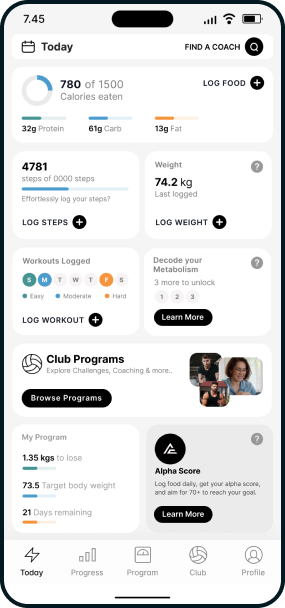
But tadka isn’t invisible. Neither is the rice, roti or ghee eaten with it. If you’re tracking calories, note the dry dal used and roughly what fraction of the pot you ate. Alpha Coach Pro or another calorie tracker will give a far better estimate than a generic “one bowl dal” entry.
FAQs
How much protein is in moong dal?
Roughly 24g per 100g dry, and much lower once cooked because of absorbed water.
What is 100 gm moong dal protein exactly?
About 23.9g according to Indian Food Composition Tables. A practical estimate is 24g.
How much cooked moong dal protein is in 100g?
Plain boiled moong is often around 7g per 100g, and watery dal can be lower, depending on how much water was used.
How much protein is in one bowl?
It depends on the dry dal used. 40g dry gives about 9-10g, 50g dry about 12g, and 75g dry about 18g.
What are moong dal calories per 100g?
Around 326 calories for dry moong dal.
Is green moong dal protein per 100g different from yellow moong dal?
Not significantly. Both sit around 23-24g dry. The real differences are fibre and cooking time.
Is moong dal good for weight loss?
Yes, especially as a simple, lightly tempered dal. The oil, ghee and accompaniments matter more for calories than the dal itself.
What to Remember
Protein in moong dal is roughly 24g per 100g dry, and a 50g dry portion gives about 12g.
Once cooked, the dal becomes heavier because of water, so protein per 100g of cooked food reads lower. The protein hasn’t vanished, it’s just diluted.
For practical tracking, start with the dry quantity whenever you can. See our other protein per 100g guides if you’re building a full high-protein vegetarian day.
 0
0










Leave a Reply