
 251 views
If you’ve been trying to gain weight but nothing seems to work, you’re not alone. Many people eat regularly, sometimes even more than others, yet struggle to see any change on the scale. This is especially common among naturally lean people, have a fast metabolism, or don’t follow a structured eating and training routine.
Healthy weight gain is not about eating junk food or forcing calories randomly. It’s about creating the right balance of calories, protein, and strength training so your body can build muscle, not just store fat.
This guide breaks down exactly how to gain weight in a way that is practical, sustainable, and effective for real life.
Quick Answer: What Actually Works for Weight Gain
If you want a simple starting point:
- You need to eat more calories than your body burns
- You need enough protein to support muscle growth
- You need strength training to convert calories into muscle
- You need to do this consistently, not occasionally
Most people don’t gain weight because they underestimate how much they eat or overestimate consistency.
Why You’re Not Gaining Weight
Before trying to fix weight gain, you need clarity on what’s actually holding you back. Most people assume they “eat a lot,” but the issue is usually how much, how often, and how consistently they eat.
1. Fast Metabolism: Some individuals naturally burn more calories throughout the day. This includes not just exercise, but also basic activities like walking, fidgeting, and even digestion. This means your maintenance calories are higher, so what feels like “a lot of food” may still not be enough to create a surplus.
2. Low Appetite: Not feeling hungry is one of the biggest barriers. You may eat until you feel full, but that level of intake might still be below what your body needs to gain weight. Relying only on hunger signals does not work well for weight gain. You often need planned eating, not just instinctive eating.
3. Inconsistent Eating: Skipping meals, delaying food, or eating irregularly breaks the calorie surplus.
Examples:
- Skipping breakfast
- Long gaps between meals
- Eating well one day and very little the next
Weight gain requires daily consistency, not occasional effort.
4. Low Protein Intake: Even if total calories are adequate, low protein intake limits muscle growth. Without enough protein, your body struggles to build lean mass, and weight gain (if any) is less effective.
Most Indian diets tend to be carb-heavy and protein-light, which slows progress.
5. No Strength Training: If you are not training, your body has no strong reason to build muscle.
- Extra calories without training lead to more fat gain
- Extra calories with training lead to muscle strength
Training acts as the signal that directs where those extra calories go.
Real-Life Patterns
Most weight gain struggles are not about “genetics alone.” They are driven by everyday habits that go unnoticed:
- Breakfast skipped or replaced with chai and biscuits
- Lunch delayed or inconsistent due to work
- Meals mostly carb-heavy with very little protein
- Eating until “full,” but not eating calorie-dense foods
- Long gaps between meals
- Relying on snacks instead of structured meals
These patterns create a situation where you feel like you are eating enough, but in reality, you are not consistently in a calorie surplus.
What This Means
Weight gain is not failing because your body is “different.”
It’s usually failing because the system is not structured.
Once you fix consistency, protein intake, and training, progress becomes much more predictable.
How to Gain Weight: What Actually Works
Weight gain is simple in theory, but it only works when the basics are applied consistently.
1. Calorie Surplus
You need to eat more calories than your body burns.
A practical starting point:
| Goal | Calories |
| Maintain weight | Your current intake |
| Gain weight | +300–500 kcal/day |
This surplus gives your body the extra energy needed to build muscle and gain weight.
2. Protein Intake
Protein is essential for muscle growth and recovery.
| Body Weight | Protein Needed |
| 60 kg | 96–132 g |
| 70 kg | 112–154 g |
A good target is 1.6–2.2 grams per kg of body weight per day.
This ensures that the weight you gain is not just fat, but also lean muscle.
3. Strength Training
Training determines how your body uses the extra calories.
- Without training, calories are stored mostly as fat
- With training, calories support muscle growth
Focus on basic compound movements like squats, pushes, and pulls.
You don’t need complex workouts. You need consistent effort.
4. Meal Frequency
Eating larger portions in one sitting can be difficult, especially if you have a low appetite.
A better approach:
- Eat 4–6 meals per day
- Add calorie-dense snacks between meals
This helps you increase total intake without feeling overly full.
5. Rate of Weight Gain
Healthy weight gain is gradual and steady.
- Target: 0.25–0.5 kg per week
This pace allows your body to build muscle while limiting excess fat gain.
Faster weight gain often comes from:
- Excess calories
- Poor food quality
- Lack of training
The goal is not just to gain weight. It is to gain quality weight.
Step-by-Step Plan to Gain Weight
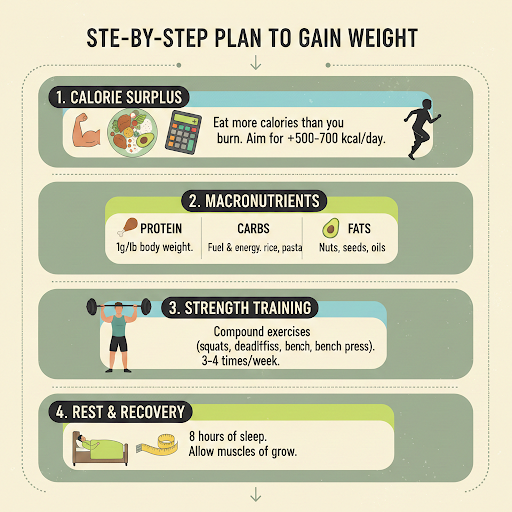
This is where most people either make progress or stay stuck. The goal is not to overhaul everything at once, but to build a system you can follow daily.
Step 1: Estimate Your Current Intake
Before increasing food, understand where you stand.
- Track everything you eat for 2–3 days
- Don’t change anything during this phase
- Note meal timing, portion sizes, and gaps
This gives you a realistic baseline. Most people realise they are eating less than they think.
Step 2: Add 300–500 Calories
Once you know your baseline, increase your intake slightly.
- Add 300–500 calories per day
- Avoid doubling your intake overnight
- Use easy additions like:
- A glass of milk
- A handful of nuts
- Extra roti or rice
Small increases are easier to sustain and reduce discomfort.
Step 3: Fix Protein Intake
Protein is non-negotiable for quality weight gain.
- Include a protein source in every meal
- Spread intake across the day instead of loading it in one meal
Examples:
- Eggs at breakfast
- Dal or paneer at lunch
- Curd or milk as snacks
This ensures your body has what it needs to build muscle.
Step 4: Increase Meal Frequency
Eating large portions at once can be difficult, especially with low appetite.
- Move from 2–3 meals to 4–6 meals daily
- Add small snacks between meals
- Focus on calorie-dense foods to avoid feeling overly full
This helps you stay in a surplus without forcing large meals.
Step 5: Start Strength Training
Training gives direction to your calorie surplus.
- Train 3–4 times per week
- Focus on basic movements
- Keep sessions simple and consistent
Without training, weight gain is less effective. With training, it becomes structured and predictable.
How to Gain Weight in the Weekly Execution Checklist
Consistency matters more than intensity. Use this as a simple system.
Daily
- Eat 4–5 meals
- Hit your protein target
- Stay in a calorie surplus
Weekly
- Track your body weight (same time, same conditions)
- If weight does not increase after 10–14 days, add more calories
This removes guesswork and keeps progress measurable.
Start Today!
If you want to take action immediately, start here:
- Add one extra meal today
- Include a protein source in every meal
- Eat a handful of nuts or peanut butter
- Do a 20–30 minute basic workout
- Track your morning body weight
Do not wait for a perfect plan. Start with these actions and repeat them tomorrow.
Diet Plan for Weight Gain
A good weight gain diet is not about eating everything. It is about eating enough of the right foods consistently.
What to Eat More
Focus on calorie-dense, nutrient-rich foods:
- Whole grains: roti, rice, oats
- Dairy: milk, curd, paneer
- Nuts and seeds: almonds, peanuts, seeds
- Healthy fats: ghee, butter, oils
- Protein foods: eggs, chicken, dal
These foods make it easier to increase calories without overeating junk.
What to Avoid
- Using junk food as your main calorie source
- Skipping meals due to schedule or appetite
- Very low-protein diets
The goal is quality weight gain, not just scale increase.
Smart Food Swaps
| Instead of | Choose This |
| Plain roti | Roti and ghee |
| Tea + biscuits | Milk + peanut butter toast |
| Small meals | Add nuts or curd |
| Skipping snacks | Add banana shake |
These swaps increase calories without making your diet complicated.
Sample Diet For A Day
Breakfast
2 eggs + toast + milk
Lunch
Roti, dal, sabzi, curd
Snack
Banana + peanut butter
Dinner
Rice with chicken or paneer + vegetables
Before Bed
Milk or curd
This structure works because it is balanced, repeatable, and calorie-sufficient.
Workout Plan for Weight Gain
Exercise is what decides how you gain weight. Without training, extra calories are more likely to be stored as fat. With the right training, those calories support muscle growth, strength, and better body composition.
You don’t need complicated programs. You need a simple structure you can follow consistently.
Minimum Plan
- Strength training 3–4 times per week
- Each session: 30–45 minutes
- Focus on basic movements
You do not need long workouts. Short, focused sessions done regularly work better than occasional intense workouts.
Simple Weekly Structure
| Day | Workout Focus |
| Monday | Upper body |
| Wednesday | Lower body |
| Friday | Full body |
| Saturday (optional) | Light session or mobility |
This structure works because it:
- Allows recovery between sessions
- Covers all major muscle groups
- Keeps training frequency manageable
Focus Exercises
Prioritise compound exercises that train multiple muscles at once:
- Squats: legs, core
- Push-ups / bench press: chest, shoulders, triceps
- Pull-ups / rows: back, biceps
- Shoulder press: shoulders, upper body
These exercises give better results because they:
- Stimulate more muscle growth
- Improve strength faster
- Use more energy efficiently
You don’t need dozens of exercises. You need the right ones, done well.
Exercise vs No Training

| Factor | With Training | Without Training |
| Weight gain quality | More muscle | More fat |
| Strength | Improves steadily | No meaningful change |
| Body shape | More defined | Less defined |
| Long-term results | Sustainable | Unpredictable |
Training doesn’t just help you gain weight. It improves how that weight looks, feels, and performs.
Low Appetite
- Focus on calorie-dense foods (nuts, shakes, milk)
- Eat smaller meals more frequently
- Avoid forcing very large meals at once
This helps you increase calories without discomfort.
Vegetarian
- Prioritise:
- Paneer
- Dal
- Soy products
- Milk and curd
- Combine foods (e.g., dal + rice) to improve protein quality
Protein planning becomes more important in vegetarian diets.
Busy Schedule
- Keep quick options ready:
- Milk
- Nuts
- Fruits
- Avoid long gaps without eating
Even 5-minute snacks help maintain your calorie intake.
No Gym Access
- Use bodyweight exercises at home:
- Push-ups
- Squats
- Lunges
- Planks
- Focus on progression (more reps, better form)
You don’t need a gym to start. You need consistency.
What This Means
The best plan is not the most advanced one.
It is the one you can repeat every week without fail.
Common Mistakes
Most people don’t fail because weight gain is difficult. They fail because of small, repeated mistakes.
- Thinking “I eat a lot” without actually tracking intake
- Skipping protein while increasing calories
- Doing too much cardio, which burns excess calories
- Expecting visible results in 1–2 weeks
- Following a plan for a few days, then stopping
Weight gain requires consistent input. If calories, protein, or training drop, progress slows down.
When Progress Feels Slow
One of the biggest reasons people quit is unrealistic expectations.
Weight gain does not happen in a straight line. It builds gradually.
What to Expect
| Phase | What Happens |
| Week 1–2 | Appetite adjusts, routine stabilises |
| Week 3–4 | Small increase in weight |
| 4–8 weeks | Visible changes begin |
What You Should Do
- Stay consistent for at least 3–4 weeks before changing anything
- Avoid reacting to daily weight fluctuations
- Focus on weekly trends, not daily numbers
Conclusion
Weight gain is not about eating randomly or forcing food. It’s about following a structured system where your calorie intake, protein, and training work together.
When you eat enough, train consistently, and track your progress, results become predictable. The process is simple, but it requires consistency.
Most people don’t fail because the plan is complicated. They fail because they don’t follow it long enough.
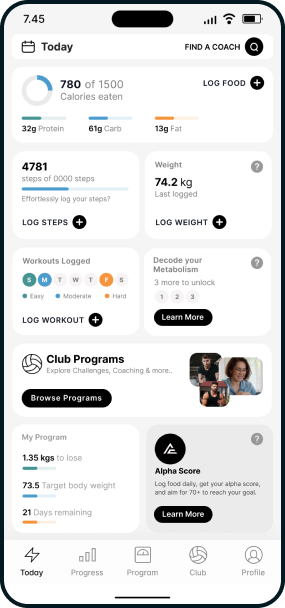
With a structured system like Alpha Coach, you can track your meals, monitor your progress, and follow a routine that actually supports weight gain. It removes guesswork and helps you stay consistent, which is what truly drives results.
Frequently Asked Questions
How to gain weight naturally?
Gaining weight naturally comes down to three things working together:
- Eating in a calorie surplus
- Getting enough protein to support muscle growth
- Following a consistent strength training routine
You don’t need supplements or extreme diets. When your meals are structured, your protein intake is adequate, and you train regularly, weight gain becomes steady and predictable.
How to gain weight fast for skinny people?
“Fast” weight gain usually means increasing calories aggressively, but doing this without structure often leads to excess fat gain.
A better approach:
- Increase calories by 300–500 kcal to start
- Add calorie-dense foods like milk, nuts, and shakes
- Train 3–4 times per week
If you want faster results, increase calories gradually, not suddenly. The goal is quality weight gain, not just scale weight.
How much protein is needed for weight gain?
Protein requirements depend on your body weight.
- Aim for 1.6–2.2 grams per kg of body weight per day
For example:
- 60 kg → ~96–132 grams
- 70 kg → ~112–154 grams
Spread this across meals instead of consuming it all at once. This supports better muscle growth and recovery.
What are the best foods for weight gain?
Focus on foods that are both calorie-dense and nutrient-rich:
- Whole grains: roti, rice, oats
- Dairy: milk, curd, paneer
- Protein sources: eggs, chicken, dal
- Healthy fats: nuts, seeds, ghee
The goal is not to eat more junk food. It is to eat more of the right foods consistently.
Why am I not gaining weight even after eating more?
This is one of the most common issues. In most cases, the problem is not effort, but consistency and accuracy.
Common reasons:
- You are still not in a true calorie surplus
- Meals are inconsistent across the week
- Protein intake is too low
- No strength training to support muscle gain
References
- Morton, R.W. et al. (2018). A systematic review, meta-analysis and meta-regression of the effect of protein supplementation on resistance training-induced gains in muscle mass and strength. British Journal of Sports Medicine.
- Slater, G.J. et al. (2019). Is an Energy Surplus Required to Maximize Skeletal Muscle Hypertrophy Associated With Resistance Training. Frontiers in Nutrition.
- Schoenfeld, B.J. et al. (2016). Effects of Resistance Training Frequency on Measures of Muscle Hypertrophy: A Systematic Review and Meta-Analysis. Sports Medicine.
- Helms, E.R. et al. (2023). Effect of Small and Large Energy Surpluses on Strength, Muscle, and Skinfold Thickness. Sports.
 0
0








Leave a Reply